THE
HIGH PRIESTS AND THE BRAHMANIC
RITUAL
There
is still another holy water of limited power that gives
.mortality, the toya amreta or amerta, which is, however,
reserved exclusively
for the gods. In relation to this elixir of imortality there
is a legend that gives the cause of eclipses: "The
mon Kala Rahu came once, out of curiosity, to take a peek
at heaven; there he saw a vessel of amreta and, thinking
himself observed, stole it and tried to drink from it.
But
Wisnu saw him and with a single blow cut off the demon's
head. Kala Rahu had taken one drink in his mouth, but did
not have time swallow it, so his body died, but his head
continued to live, and now, as revenge, he swallows the
sun and the moon, producing the eclipses. Thus when an eclipse
occurs, the Balinese are frightened and they all go out
of their houses to make all the noise possible, beating
kulkuIs, tin cans, drums, and gongs to frighten away the
bodyless head of Kala Rahu and free the threatened sun or
moon.
The
religious service of the pedandas, the maweda, consists
.the recitation of the mantras, the magic formulas, accompanied
by ritual actions and significant gestures of the hands
and fingers (mudra) to give a physical emphasis to the spoken
word Through concentration culminating in a trance, the
priest comes the deity itself, entering the body of the
priest and and acting through it to consecrate the water
and emanate divine vibrations.
A
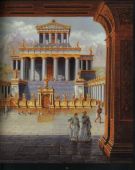
performance of maweda by an able priest is one of the m,
beautiful sights in Bali. Such finished training, such showmanship,
enters into its execution, and the hand gestures of t priest
are so thoroughly imbued with rhythm and beauty, that the
maweda is more than a simple prayer; it is a whole spectacle
pantomimic dance of the hands. I have once seen a revealing
film of a Nepalese Buddhist priest dancing with his entire
body while he recited Sanskrit mantras and performed the
symbolical hand gestures, and I have wondered if this was
not the origin of the great art of Balinese dancing.
Volumes
have been written on the hand expression of the Hindus;
The Mirror of Gesture commaraswami is already a classic;
the beautiful hands of Indian, Tibetan, Chinese, and Indonesian
Buddhist statues and frescoes are well known, and in Java
we find the statues of the Buddha of Borobudur in the positions
of the mudras. De Kat Angelino in his Mudras gives us the
most thorough study up to date the Balinese maweda, painstakingly
illustrated by Tyra de Kleen Only a moving picture, however,
could give an idea of its eerie beauty.
The
most important activity in the everyday life of the pedandas
is the performance of a domestic maweda, done every morning
and on an empty stomach. Every fifth day (klion) and on
days of full and new moons, the maweda is essential and
more complete, with the full regalia of important occasions.
links
[ 1
] - [
2 ] - [
3 ] - [
4 ] - [
5 ]
- [
6 ] - [
7 ] - [
8 ]