DEATH
AND CREMATION
STRANGE
AS IT SEEMS, it is in their cremation ceremonies that the
Balinese have their greatest fun. A cremation is an occasion
for gaiety and not for mourning, since it represents the
accomplishment of their most sacred duty: the ceremonial
burning of the corpses of the dead to liberate their souls
so that they can thus attain the higher worlds and be free
for reincarnation into better beings.
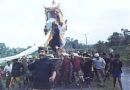
At cremation ceremonies hundreds of people in a wild stampede
carry the beautiful towers, sixty feet high, solidly built
of wood and bamboo and decorated with tinsel and expensive
silks, in which the bodies are transported to the cremation
grounds. There the corpses are placed in great cows (hewn
out of tree-trunks to serve as coffins and covered with
precious materials) , and cows, towers, offerings, and ornaments
are set on fire, hundreds and even thousands of dollars
burned in one afternoon in a mad splurge of extravagance
by a people who value the necessities of life in fractions
of pennies.
To the Balinese, the material body is only the shell, the
container of the soul. This soul lives in every part of
the body, even in the hair and nails, but it is concentrated
in the head which is near-holy to them. A Balinese observes
the rank of his head in relation to the rest of his body,
and for this reason no one would stand on his head or take
any position that would place his feet on a higher level.
It is an offence even to pat a small child on the head and
there is no worse insult than " I'll beat your head!
" One's soul wanders away during sleep (dreams are
its travels and adventures) , without becoming, however,
entirely detached from the body, and it is considered dangerous
to awaken a person too suddenly. Children are never beaten,
so as not to shock their tender, still undeveloped souls.
Madness,
epilepsy, and idiocy are the results of a bewitched soul,
but ordinary sickness is due to a weakened, polluted soul
rather than to mere physical causes. Life vanishes when
the soul escapes from the body through the mouth, and death
occurs when it refuses to return. The relatives of a dying
man who has lost consciousness go to the temple of the dead
and, through a medium, beg the deities for the release and
return of his soul.
By
force of habit, the soul lingers near the body when death
comes, and remains floating in space or lives in a tree
near by until liberated by the obliteration of the corpse
by the elements: by earth, by fire, and by water, to destroy
the last unclean tie that binds the souls of the dead to
this earth. By cremation the soul is released to fly to
the heavens for judgment and return to be reborn into the
dead man's grandchildren. Failure to liberate the soul by
neglecting to perform the cremation or by incomplete or
improper rites would force the soul to turn into a ghost
that would haunt the careless descendants.
Cremation
rites were probably not introduced into Bali until the time
of Madjapahit, about the thirteenth century, but the ancient
Balinese animists already believed that their life-fluid
was immortal and that after death it returned to animate
other beings. They practised the obliteration of the corpse
by burial or, as is still done in the primitive village
of Sembiran, simply by abandoning the bodies in the forest
at the edge of a ravine to be eaten by wild animals.
A man in Bali is born into a superior state - a higher caste
- if his behaviour on this earth has been good; otherwise
he will reincarnate into a lower stage of life to begin
over again the progressive march towards ultimate perfection.
A man who is guilty of serious crimes is punished by being
reborn, often for periods of thousands of years, into a
tiger, a dog, a snake, a worm.
links
[ 1 ] - [
2 ] - [ 3 ]