THE
HIGH PRIESTS AND THE BRAHMANIC
RITUAL
A
pcdanda marries, generally only once, a woman of his own
caste, who becomes automatically a priestess (pedanda istri)
, who must help her husband in the ritual and who may herself
officiate on certain occasions. High priests do not observe
sexual abstinence, although it is recommended in the scriptures.
Ancestrv is one of their great concerns, and the standing
of the various Brahmanic families is determined by their
purity of lineage.
Balinese
Brahmanas all claim descent from the mythical Wau Rauh,
the highest priest of Madjapahit, who in coming to Bali
took wives from the various castes. His descendants established
themselves at various places in Bali and founded the Brahmanic
clans we find today, from the purer Kamenuh, to the Keniten,
Gelgel, Nuaba, Mas, Kayusunia, Andapan, and so forth.
Pedandas should dedicate their entire life to meditation,
the study of theology, and the practice of the ritual. During
life they are supposed to be models of knowledge, purity
of thought and of actions, but unfortunately this is not
always the case and, as everywhere else, there are priests
who take advantage of their position and by their mysterious
hocus-pocus exploit the people. In Bali, however, this occurs
on a considerably smaller scale than in countries dominated
by an organized clergy. The Brahmanas jealously keep the
inner knowledge of the official religion for themselves
and the common people believe in them, but continue to regard
them, like their princes, as foreigners aloof from the true
life of Bali.
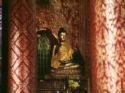
The Brahmanic priesthood is today divided into two great
groups: the Siwaites (siwa or siwa sidanta) , and the so-called
Buddhists (bodda) ; not true followers of Siwa and of the
Buddha, but simply sectarian divisions of the same religion.
The pedanda siwa wears his hair long, tied in a knot on
the top of his head, while the pedanda bodda has his cut
shoulder-length; otherwise their office and ritual are the
same with only small differences in detail, in phraseology,
and in the texts used by each.
To
the average Balinese this division means so little that
he will call a priest of either sect to officiate for him
regardless of whether he is siwa or bodda, simply because
of personal preference or family tradition or because the
priest's house may be nearer. To him two priests of two
sects are undoubtedly more effective than one, but this
is an expensive luxury that only the princes can afford.
The present Regent of Gianyar always engaged both a pedanda
siwa and a pedanda bodda, who sat side by side
.
He went even further and had also a Satria priest, a resi,
and a sunguhu to take care of the evil spirits, so that
every sort of priest was represented. In Badung I have seen
ceremonies with nine priests officiating, one for each of
the cardinal points.
From India the Brahmanic priests inherited a good portion
of the sacred Sanskrit writings of the Hindus, such as portions
of the Vedas, called in Bali Weda, containing the most powerful
secret formulas for the private use of the priests; the
Brahmanda-Purana, a treatise on cosmogony, mythology, and
mythic chronology;
and the Tuturs, the doctrinal writings of the pedandas.
In this manner the priests preserved the knowledge of Sanskrit,
the really sacred language of Bali, which is, however, only
known by the name of sloka, the metre in which Sanskrit
works are written. The learning of Sanskrit is kept a secret
among the priests and should not be confused with the Kawi,
which is only the classic language of poetry, well knowe
to the nobility and to scholars in general.
links
[ 1
] - [
2 ] - [
3 ] - [
4 ] - [
5 ]
- [
6 ] - [
7 ] - [
8 ]