NOTES
ON DEATH AND CREMATION
The
naga banda itself consisted of a long rope bound in green
cloth with an elaborate head of carved and painted wood
and with a great mane of Wang grass. It measured one hundred
yards, although I was told that according to regulations
it should have been 1,6oo depa (a depa is about one yard).
The naga handa is made alive by a pedanda bodda, and a pedanda
siwa kills it, in a sort of battle of wits between the magic
of the two sects, but in Den Pasar the ceremony had not
taken place for a decade and the older priests were afraid
to attempt it.
The formulas employed for this are the most difficult tongue-twisters
and they claimed that the slightest mistake would result
in the death of the priest himself. Nobody would undertake
it except the young but mystic pedanda Gede of Pemetjutan,
of whom it was said he was so studious that he once lost
his mind temporarily, trying to learn a difficult mantra.
He agreed to perform both, give life to and then kill the
naga banda, a great test of his powers.
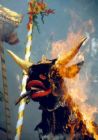
On
the day of the cremation the great serpent was the most
spectacular part of the procession; hundreds of people clung
to it, and the priest himself, dressed in full regalia,
rode on its neck, the bow and arrow with which to kill it
in his right hand, in the left his bell, which he rang all
the way to the cemetery. The tail of the serpent was held
by the present Regent of Badung, a descendant of the old
Radja, while in the other hand he held the effigy; he rode
on the tower where the corpse should have been.
At
the cremation ground the priest shot imaginary arrows to
the four winds and then towards the serpent. That was a
moment of suspense because the great throng watched breathlessly
to see if the red hibiscus on each side of the snake's head
wilted. It is believed that should the flowers remain fresh
until the end of the ceremony, the priest has failed to
kill it and he himself will die instead. It was a hot afternoon,
the hibiscus soon wilted, and all was well.
links
[ 1 ] - [
2 ]